

There isn't one best flooring for a Chicago patio or sunroom, and anyone who tells you otherwise hasn't dealt with a Midwest winter. The material that holds up on a fully exposed concrete patio is often the wrong choice for an enclosed three-season room, and vice versa. Four separate conditions decide the right answer: whether your patio sits open to the weather, sits under a roof, belongs to an unheated three-season room, or lives inside a fully conditioned four-season sunroom.
For an exposed patio, concrete pavers or 2cm porcelain pavers set over a properly drained base outperform poured concrete almost every time our regional freeze-thaw cycles get involved. For a sunroom or three-season porch, porcelain tile installed over an uncoupling membrane is the most consistently reliable option, with waterproof laminate or cold-rated SPC as a second choice depending on how the space is heated. Standard luxury vinyl plank, despite its popularity indoors, carries real risk in an unconditioned room. The rest of this guide breaks down why, with the specific failure points Chicago homeowners run into and the fixes that actually hold up.
The Four Space Types That Decide Your Flooring
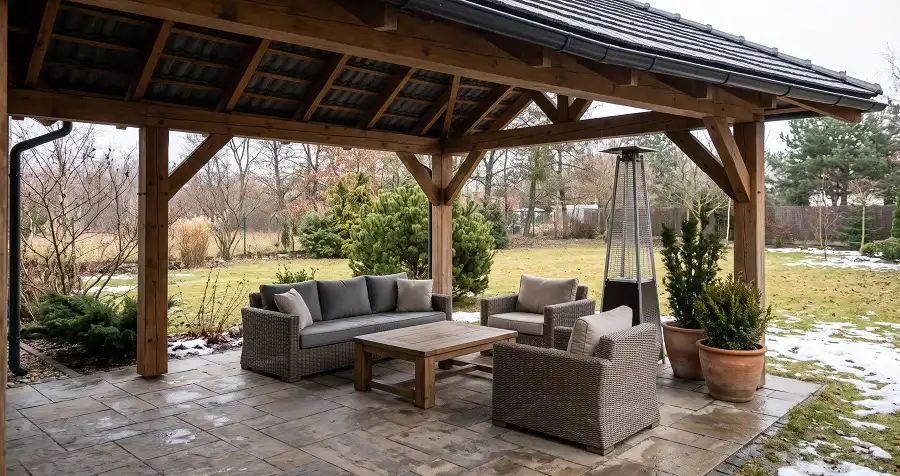
"Open patio" means a slab or paver surface with no roof overhead. It takes direct snow, rain, UV, and every freeze-thaw cycle the season throws at it, so drainage and frost resistance decide which material survives.
"Covered patio" has a roof but no walls. It's protected from snow accumulation and most rain, but temperatures still swing with the outdoor air, and materials still need to handle humidity and occasional wind-driven moisture.
"Unheated three-season room" is enclosed with windows but has no heating system, or the heat simply gets shut off for the coldest months. It faces close to the same temperature extremes as the outdoors, just without direct precipitation, and that combination creates its own, very specific failure points covered later in this guide.
"Four-season sunroom" is insulated and conditioned like the rest of the house. Once that's true, most interior flooring options become fair game, and the decision looks a lot more like choosing flooring for any other room in your home.
What Actually Destroys Flooring in a Chicago Winter
Chicago doesn't give flooring a break. According to National Weather Service records, the city's official temperature extremes span more than 130 degrees, from a record high of 105°F to a record low of -27°F, and even a typical year swings from average lows in the high teens in January to average highs in the mid-80s in July. Every material installed outside or in an unconditioned space has to survive both ends of that range, repeatedly, for years.
The physical damage mostly comes down to water. Water is one of the few substances that expands as it freezes rather than contracts, gaining roughly 9 percent in volume, a basic property of ice covered in any physics or materials-science reference. When water trapped inside concrete, stone, or an improperly sealed joint freezes, that expansion is what causes surface scaling, cracked mortar joints, and pavers that visibly lift and shift. Chicago's native soil doesn't help: the region's dense clay and glacial till drain poorly and hold moisture close to the surface, and Section 14B-18-1809 of Chicago's Building Code requires footings to sit at least 42 inches deep specifically to get below the frost line.
Most patio failures trace back to the base, not the surface material. A patio built over a traditional dense-graded gravel base, the kind packed with fine stone dust, traps water underneath the pavers. When that water freezes, it heaves unevenly and throws the whole surface out of level. An open-graded base built from clean crushed stone wrapped in geotextile fabric lets meltwater drain straight through instead of pooling, which is the principle behind permeable paver systems.
Road salt adds a second layer of stress. Deicing salt keeps the surface wetter and makes each freeze-thaw cycle more damaging, which accelerates scaling on anything porous. None of this means every material is doomed. It means the materials that hold up here are the ones engineered to manage water movement, not just resist water exposure.
Best Flooring Options for Outdoor Patios
For a fully exposed or covered patio, the materials that hold up in the Chicago area share one trait: they manage water instead of absorbing it. Here's how the main options compare once a few winters have tested them.
Patio Flooring Materials in Chicago's Climate
Concrete Pavers
Interlocking concrete pavers remain the standard recommendation for Chicago-area patios, and the reason has almost everything to do with the base beneath them. Properly set over a deep, compacted crushed-stone base, individual pavers can be lifted, releveled, and reset if one section settles, without tearing out the whole patio. The tradeoff is joint sand, which needs topping up whenever it washes or erodes out of the joints.
Porcelain Pavers (2cm)
Exterior-rated 2cm porcelain pavers fall into the ANSI "impervious" category, meaning they absorb 0.5 percent or less of their weight in water, which makes them close to immune to the freeze-thaw cracking that affects more porous materials. They also resist staining and never need a topical sealer. The catch is installation tolerance: these pavers are thin and rigid, so they need a carefully leveled base or a pedestal system, and a shortcut here shows up as cracked corners within a season.
Natural Stone
Thermal-cut bluestone, the kind finished with a flame treatment rather than left in its natural cleft, gives a flat, textured surface that resists water pooling. Irregular cleft stone and flagstone split along natural layers, and water that gets into those layers and freezes can make the surface flake.
Stamped Concrete: The Honest Tradeoffs
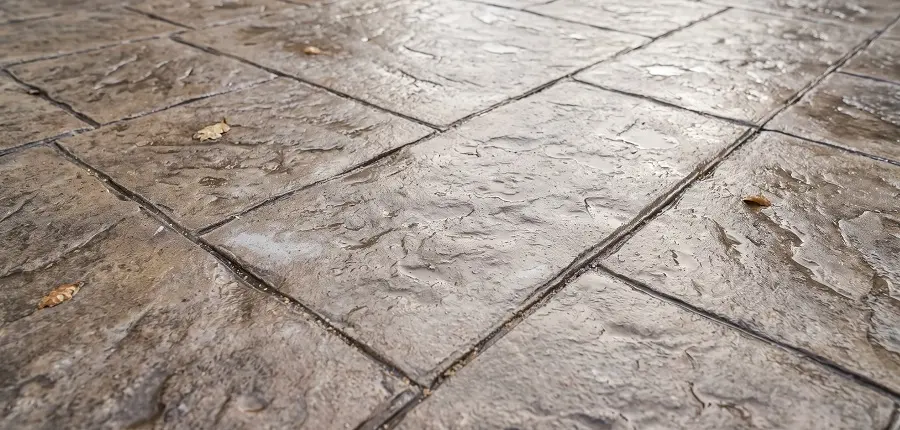
Stamped concrete is a popular one-pour option, and plenty of homeowners who choose it later regret it. The acrylic sealers that keep its color need reapplication every two to three years, and when moisture gets trapped underneath that sealer, it turns milky and blotchy. The same sealed surface also gets noticeably slick in rain, melting snow, or morning frost.
Sweaty Slab Syndrome: The Hidden Problem in Unheated Sunrooms
Commercial flooring contractors have a name for this problem: sweating slab syndrome, a recognized condition in the concrete and flooring industry where a slab's surface condensates because it sits colder than the dew point of the air above it. Most homeowners have never heard the term, but plenty of them have lived through it without a name for it. In a residential setting, it happens in three-season rooms and enclosed porches built over an uninsulated, grade-level concrete slab. During the spring transition, typically April through June, warm and moisture-laden outdoor air moves into the space and meets a slab that's still thermally connected to deep ground temperatures, which stay well below the warming outdoor air for weeks at a time. When humid air touches that cold surface, it drops below its dew point and condenses right there on the floor.
A homeowner installs indoor-outdoor carpet or a fully sealed vinyl floor over a slab like this, expecting a waterproof surface to solve their moisture concerns. Instead, the trapped moisture has nowhere to go. It pools under the carpet backing or foam underlayment, feeding mold colonies and a musty smell that gets worse every spring instead of better.
This is also where capillary moisture becomes a factor even without visible flooding. Water drawn up through unsealed concrete can sit under a floor covering for months before anyone notices a problem. If your three-season room has a history of dampness or sits near a spot prone to sewer backup, a subfloor and moisture assessment before installing anything new is worth the hour it takes.
Best Flooring Options for Sunrooms and Three-Season Rooms
Once you've ruled out the moisture and condensation issues above, the material choice for a sunroom or three-season room comes down to two questions: how wide a temperature range the space experiences, and whether it's conditioned year-round. The options below are ranked roughly by reliability in Chicago's unconditioned spaces, starting with the one installers trust the most. Material prices in the table are Simple Flooring's published ranges.
Sunroom Flooring Materials by Temperature Tolerance
Porcelain Tile with an Uncoupling Membrane
Porcelain tile installed over an uncoupling membrane, such as Schluter Ditra, is consistently the most reliable flooring for an unconditioned sunroom. The membrane sits between the slab and the tile and absorbs the lateral stress created when the concrete expands and contracts, which keeps that movement from cracking the tile or grout above it. Porcelain itself carries a water absorption rating under 0.5 percent, so sub-zero cold and high humidity don't degrade it the way they degrade softer materials.
The one real complaint is temperature underfoot. Tile over an uninsulated slab stays cold from late fall through spring unless you add an electric radiant heating element beneath it, which is a realistic upgrade if you want to use the room earlier in spring and later into fall. Our tile installation team can walk you through whether a membrane and radiant layer makes sense for your specific slab.
Why Standard LVP Struggles in an Unheated Room
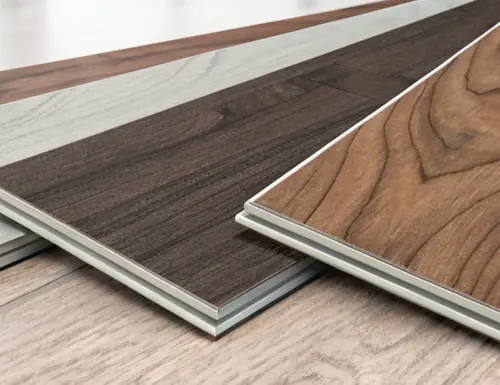
Luxury vinyl plank is a popular choice for the rest of the house, and for good reason: it's water-resistant, comfortable underfoot, and holds up well to foot traffic and pets. In an unconditioned three-season room, though, standard flexible LVP runs into a problem that has nothing to do with water. As temperatures fall toward the low end of a typical unheated Illinois winter, the plasticizers that keep it flexible start to stiffen, and the click-lock joints holding the planks together become brittle enough to snap under ordinary foot traffic.
Manufacturer installation and warranty terms commonly specify an environment that stays within 55 to 85 degrees Fahrenheit year-round, and an unheated three-season room routinely falls outside that window for months at a time, which means a cracked plank may not be covered. If you're set on a vinyl look for a space like this, read our full breakdown of luxury vinyl plank pros and cons before you buy, specifically the section on heat sensitivity.
Waterproof Laminate and SPC: When They Work
Stone Plastic Composite flooring, built around a dense limestone-polymer core instead of a flexible vinyl one, holds its shape across a much wider temperature range than standard LVP. Some commercial-grade SPC lines are marketed with wider temperature tolerance for unconditioned spaces, so it's worth asking specifically which line you're being quoted and what its documentation actually covers before you buy, rather than assuming every SPC product performs the same way. Waterproof laminate is a similarly solid middle-ground choice for a three-season room that gets occasional heat, as long as the manufacturer's humidity and temperature range actually covers your conditions rather than an idealized best case.
#cta_start
Not Sure If Your Sunroom's Temperature Swings Rule Out a Material You Like?
Our installers can check your space and tell you straight whether it will hold up.
#cta_end
What Installation Costs in Chicago
Costs for patio hardscape and sunroom flooring vary more than most homeowners expect, mostly because of what's happening below the visible surface. On the hardscape side, base excavation and compacted stone add to the price on top of the pavers themselves, and porcelain pavers cost more to install because the installation tolerance is less forgiving. That work falls to a hardscape or masonry contractor, not a flooring company, so get it quoted separately from whatever goes inside the sunroom.
Interior-side flooring for a covered patio or sunroom is priced differently, and the material costs in the table above don't include installation. Porcelain and ceramic tile material costs there run alongside a modest additional step for the uncoupling membrane. Water-resistant laminate material lands in the $4 to $6 per square foot range, and standard LVP material runs $2 to $7 per square foot as shown above. Installed, both laminate and luxury vinyl run $6 to $12 per square foot in Simple Flooring's cost calculator, depending on subfloor condition and whether leveling work is needed first.
Where to Go from Here
The honest answer to "what's the best flooring for outdoor patios and sunrooms" is that it depends on four specific conditions, not on a single product category. Match the material to how exposed, covered, heated, or unheated your space actually is, and most of the expensive mistakes on this list become easy to avoid.
If you're still weighing flooring for a covered patio, three-season room, or sunroom, Simple Flooring Company has installed tile, vinyl, and waterproof laminate through enough Chicago winters to know which materials hold up in an unconditioned space and which ones don't. Reach out through our contact page or call to talk through your specific space before you buy anything.